November 5, 2026
A practical guide to domestic mission trips for churches, youth and college groups: what the work looks like, how to prepare safely, and what NYC trips cost.

We also accept other Non-Traditional Gifts.
Click here to learn more
We also accept other Non-Traditional Gifts.
Click here to learn more
We also accept other Non-Traditional Gifts.
Click here to learn more
We also accept other Non-Traditional Gifts.
Click here to learn more
We also accept other Non-Traditional Gifts. Click here to learn more
We also accept other Non-Traditional Gifts. Click here to learn more
Homeless Outreach NYC: Book a Mission Trip With Nysum
August 4, 2026
Mission Trips for Churches: Practical, Partner-First Options
August 10, 2026New York School of Urban Ministry

The safest path for most congregations: adopt a tiered, position-based screening policy, run FCRA-compliant checks through a dedicated consumer reporting agency (CRA), and pair that vendor screening with structured on-boarding and training. Start with your highest-risk roles — children’s ministry, youth overnight trips, drivers, and anyone handling finances — and work outward from there. re-screen those volunteers every 2–3 years; check your insurance policy, as some require annual or 18-month cycles for certain high-risk roles.
Quick shortlist:
Legal anchors to keep in mind: the FCRA governs how you use a CRA, the National Sex Offender Public Website (NSOPW) is the federal registry baseline, and state laws add requirements that vary significantly — especially for licensed childcare programs and camps.
A tiered, FCRA-compliant screening policy paired with structured volunteer training is the most defensible safe-environment program a church can build.
| Point | Details | ||||||||||||||||||||||||
|---|---|---|---|---|---|---|---|---|---|---|---|---|---|---|---|---|---|---|---|---|---|---|---|---|---|
| Use a tiered screening matrix | Map every role to Tier 1, 2, or 3 and run the appropriate check depth before placement. | ||||||||||||||||||||||||
| Checks are one layer, not the whole system | Written policies, the two-adult rule, mandatory reporter training, and interviews are equally necessary. | ||||||||||||||||||||||||
The table below maps each option against the dimensions that actually drive a purchase decision. Pricing shapes vary by package; contact vendors directly for current per-check quotes.
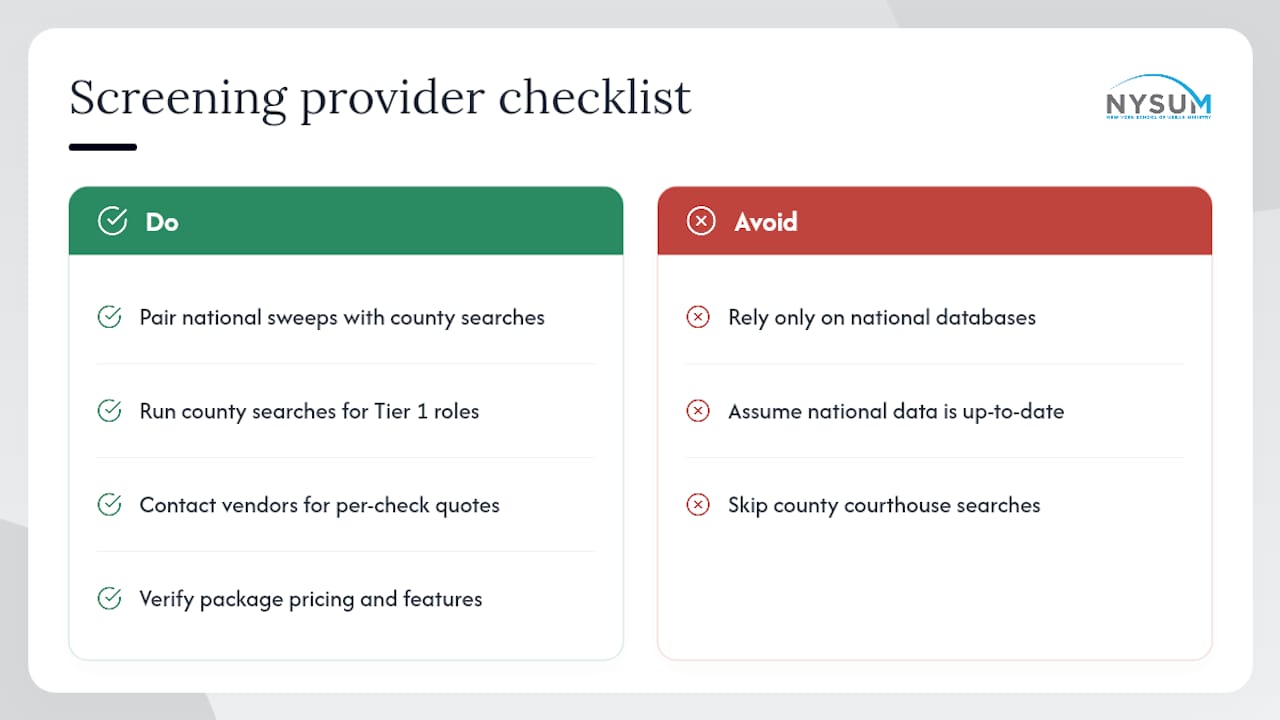
A note on search depth: national database sweeps should be paired with county courthouse searches for any Tier 1 role. National databases are aggregated and often lag by weeks or months; county records are the most current source because most crimes are prosecuted at that level.
Protect My Ministry is the most widely used church-specific CRA in the United States. Its platform is built around ministry workflows — consent forms, position-based packages, and policy templates are included rather than bolted on. For a mid-size congregation running checks on 30–100 volunteers a year, it covers the full compliance loop without requiring a separate HR department.
MinistrySafe takes a training-first approach. The background check is one component of a broader safety system that includes sexual abuse awareness training and written policy frameworks. If your church has had gaps in safe-environment education, not just screening, MinistrySafe addresses both in one subscription. The curriculum is attorney-developed and specifically designed for child-serving ministries.
Lifeway One Source (CIA) suits churches already purchasing through Lifeway’s catalog. The value is procurement simplicity and volume discounts, not a specialized compliance workflow. For a large church with a dedicated administrator, it works. For a small congregation that needs hand-holding on FCRA steps, one of the dedicated CRAs above is a better fit.
Pro Tip: Before signing with any CRA, ask one direct question: “Do you perform county courthouse searches with human review, or do you rely solely on aggregated database records?” The answer tells you more about accuracy than any marketing page.
Tiered screening matrices match the depth of a check to the actual risk of a role. A reasonable starting framework:
No single federal law mandates background checks for every church, but three forces make screening a practical necessity: the FCRA (when you use a CRA), state statutes (especially for licensed childcare and camps), and insurance requirements. Many insurers effectively require regular screening for youth-facing roles as a coverage condition. Check your policy language before finalizing your program.
A basic national sweep plus sex-offender check typically runs a modest fee per person. Adding county searches and an MVR pushes costs higher, but for Tier 1 roles, that investment is justified.
FCRA processes are the most common compliance failure for churches — a missed pre-adverse notice or a missing Summary of Rights can expose the organization to liability. The required steps:
When evaluating a CRA, confirm these points before signing a contract:
Vendor evaluation criteria should include turnaround time, record reach, submission workflow, monitoring options, and customer support, not just price.
Re-screen high-risk volunteers every 2–3 years; some insurers require annual or 18-month cycles for nursery and youth roles. Continuous monitoring services flag new criminal activity between full re-screens and are increasingly required for high-risk placements.

For records: retain background-check files for a documented period (five years is a widely cited benchmark), restrict access to a small group of authorized personnel, and store files in encrypted digital systems or locked physical storage.
Pro Tip: Run a pilot cohort of 5–10 Tier 1 volunteers before full rollout. It surfaces consent-form gaps, turnaround surprises, and adverse-action workflow questions before they affect your whole program.
A background check tells you what a person has been caught doing. It says nothing about unreported behavior, and it cannot predict future conduct. The USCCB’s safe-environment guidance is explicit on this: checks are one layer of protection, not the whole system.
The complementary practices that close the gaps:
Structured on-boarding and orientation do more than transmit policy. When volunteers understand why the two-adult rule exists, why consent forms matter, and what the church’s reporting chain looks like, compliance rates rise and ambiguous situations get reported faster. NYSUM’s volunteer orientation model, built around urban ministry contexts, demonstrates this: pairing screening with intentional training creates a culture of accountability that a background check alone cannot build.
Pro Tip: Small churches with tight budgets should prioritize Tier 1 roles first. Use the free NSOPW.gov registry search for initial screening of Tier 3 volunteers, and reserve paid county searches for anyone in a high-risk role.
Most churches that get into trouble with volunteer safety did not skip background checks entirely. They ran checks inconsistently, skipped the FCRA steps, or treated the check as the finish line rather than the starting point.
The practical recommendation: protect children and finances first, build the policy document before you order the first check, and pick a CRA that walks you through the adverse-action workflow rather than leaving you to figure it out. Pair that vendor with structured on-boarding. The screening tells you who is eligible; the orientation tells them what is expected.
Start this quarter with a pilot cohort of your Tier 1 volunteers. Document the policy. Schedule a training session. Those three steps, done in 30 days, put you ahead of most congregations.
NYSUM is not a background-check provider. What NYSUM offers is the piece most screening vendors do not: structured volunteer orientation, safe-environment training, and mission-trip preparation that gives your team the policy context and ministry skills to serve well after they clear a check.
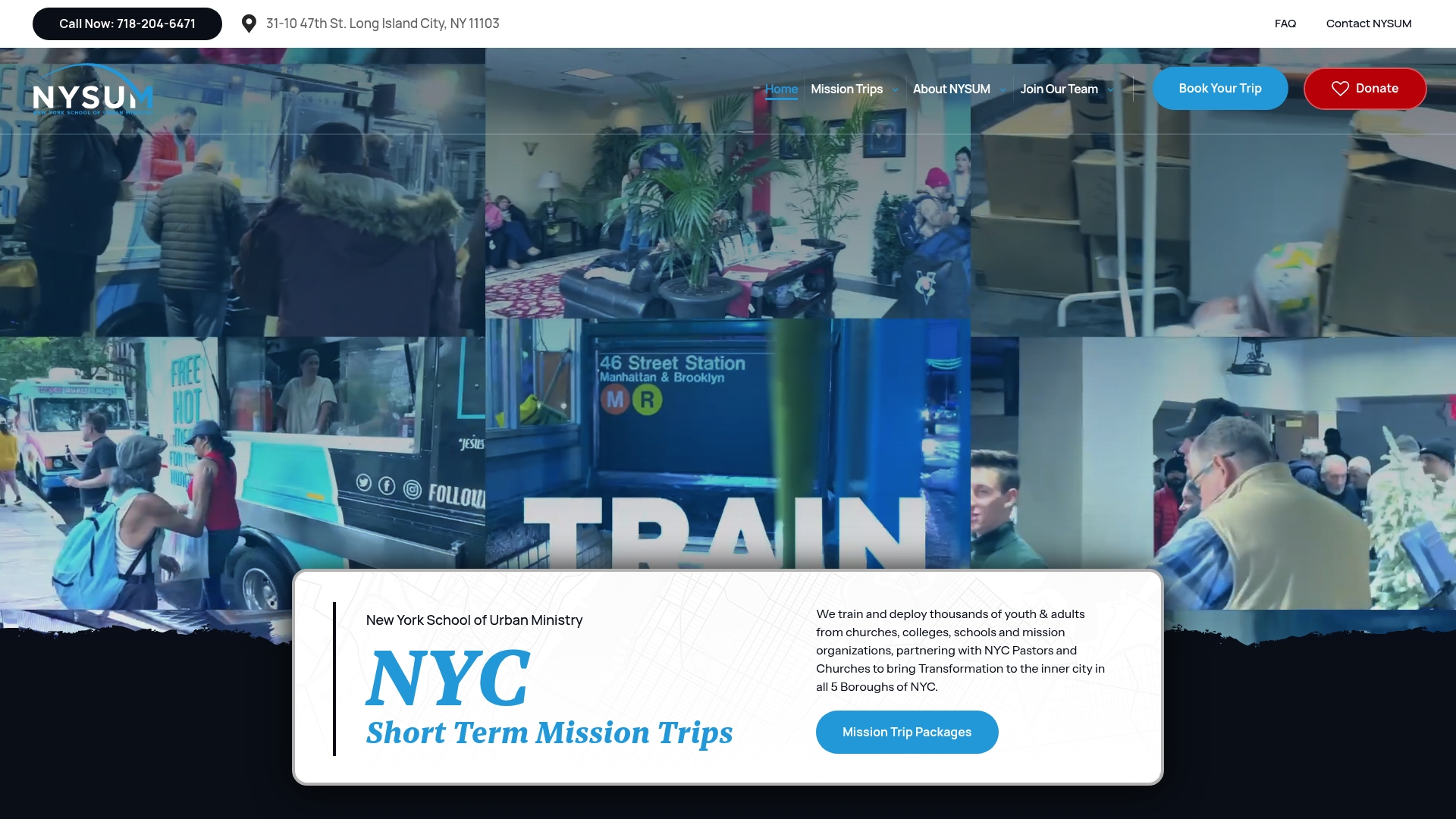
Church leaders who book ministry packages through NYSUM get hands-on training in urban outreach contexts, including children’s programs, compassion outreach, and cross-cultural ministry across New York City’s five boroughs. That training is a direct complement to whatever CRA you choose. NYSUM’s training campus hosts groups year-round, and orientation sessions can be scheduled alongside your existing screening rollout. To explore how NYSUM’s on-boarding resources fit your volunteer program, visit the volunteer page or reach out to schedule a campus session.
NYSUM does not conduct background checks and does not replace a licensed consumer reporting agency. For FCRA-compliant screening, use one of the dedicated vendors listed in this guide.
State laws vary significantly, particularly for licensed childcare programs and youth camps. Review your state’s statutes and your insurance policy requirements before finalizing any screening program.
This article is general information, not a substitute for advice from a qualified lawyer. Consult a qualified legal professional about your own circumstances before acting on anything here.
No single federal law requires every church to screen volunteers, but the FCRA applies whenever you use a consumer reporting agency, and many state laws impose mandatory checks for anyone working with children in licensed settings. Insurance requirements often make regular screening a practical condition of coverage.
For youth-facing roles, run a county criminal search, a national criminal database sweep, a sex-offender registry check, and an SSN/identity trace at minimum. Add an MVR for drivers. This combination, recommended by the Nonprofit Risk Management Center, covers the most common gaps in a single package.
Industry guidance recommends re-screening active volunteers every 2–3 years. Some insurers require re-screening annually or every 18 months for nursery workers and youth ministry staff. Continuous monitoring services can flag new criminal activity between full re-screens.
Before declining a volunteer based on a background check, provide the individual with a copy of the report and the FCRA Summary of Rights, allow a reasonable waiting period (typically five business days) for a response, and then send a final adverse-action notice if you proceed. Skipping any step is a common and costly compliance error.
No. NYSUM provides volunteer orientation, safe-environment training, and mission-trip preparation, not FCRA-compliant background screening. Use a licensed CRA such as Protect My Ministry or MinistrySafe for checks, and pair that with Nysum’s on-boarding and training resources for a complete program.
Tel: 718.204.6471 | Email: info@nysum.org
This website uses cookies
We use cookies to personalise content and ads, to provide social media features and to analyse our traffic. We also share information about your use of our site with our social media, advertising and analytics partners who may combine it with other information that you’ve provided to them or that they’ve collected from your use of their services.
Cookies are small text files that can be used by websites to make a user's experience more efficient.
The law states that we can store cookies on your device if they are strictly necessary for the operation of this site. For all other types of cookies we need your permission. This means that cookies which are categorized as necessary, are processed based on GDPR Art. 6 (1) (f). All other cookies, meaning those from the categories preferences and marketing, are processed based on GDPR Art. 6 (1) (a) GDPR.
This site uses different types of cookies. Some cookies are placed by third party services that appear on our pages.
You can at any time change or withdraw your consent from the Cookie Declaration on our website.
Learn more about who we are, how you can contact us and how we process personal data in our Privacy Policy.
Please state your consent ID and date when you contact us regarding your consent.